

Choosing between an accessible shower and a bath is rarely a matter of personal preference alone. For anyone living with reduced mobility, a long-term health condition or the effects of ageing, it is a decision that directly affects safety, independence and quality of life.
The bathroom presents more physical challenges than almost any other room in the home. Wet surfaces, difficult transfers, restricted turning space and the demands of standing, bending and balancing all increase the risk of falls and injury.
Around a third of people over 65 sustain a fall at least once a year in the UK, and the bathroom is consistently one of the most common locations for those falls.
At Aquadapt, we work with homeowners, families, occupational therapists and case managers across the UK, helping them design bathrooms that restore confidence and independence. As part of the CoreCare Global group of companies, our aim on every assignment is to find the right solution for the person, the property and the future.
Jump straight to…
-
- The Short Answer
- Start With the Person, Not the Product
- When an Accessible Shower Is Often the Better Choice
- When a Bath May Still Be the Better Choice
- Side-by-Side Comparison
- Why the Layout of Your Home Can Change the Answer
- What an OT Will Usually Look At
- Cost, Grants and the Funding Question
- Shower or Bath? Ask These Seven Questions First
- Which Is Right for You?
- Frequently Asked Questions
The Short Answer
For many people with reduced or changing mobility, an accessible shower is the safer long-term choice. A level-access shower or wetroom removes one of the biggest everyday hazards in the bathroom, stepping over a bath rim, and creates a space that can adapt as needs change over time.
But that does not make a bath automatically wrong. In some homes, and for some people, a bath remains the better fit, particularly where warm-water immersion is important for pain management, where bathing is deeply embedded in someone’s routine and wellbeing, or where the person can continue to bathe safely with the right equipment and support. Accessible living is not about stripping away choice. It is about making the choice safe and sustainable.
Start With the Person, Not the Product
This is where the best bathroom decisions begin. Before anyone chooses between a shower and a bath, it is worth stepping back and asking a few straightforward questions. Can the person step over a bath side safely? Can they lower themselves down and get back up again without pain, instability or help? Can they stand long enough to shower comfortably, or would a seat be needed? Is there a wheelchair, walker or carer involved? Is the need short term, or is there a requirement to future-proof the bathroom for the years ahead?
These are exactly the kinds of person-centred, independence-focused questions that occupational therapists are trained to consider. A bathroom adaptation that works on paper but feels distressing or unmanageable in daily life is not a very good adaptation. The right starting point is always the individual, their capabilities, their preferences, their prognosis and their daily routine.
When an Accessible Shower Is Often the Better Choice
Lower transfer risk
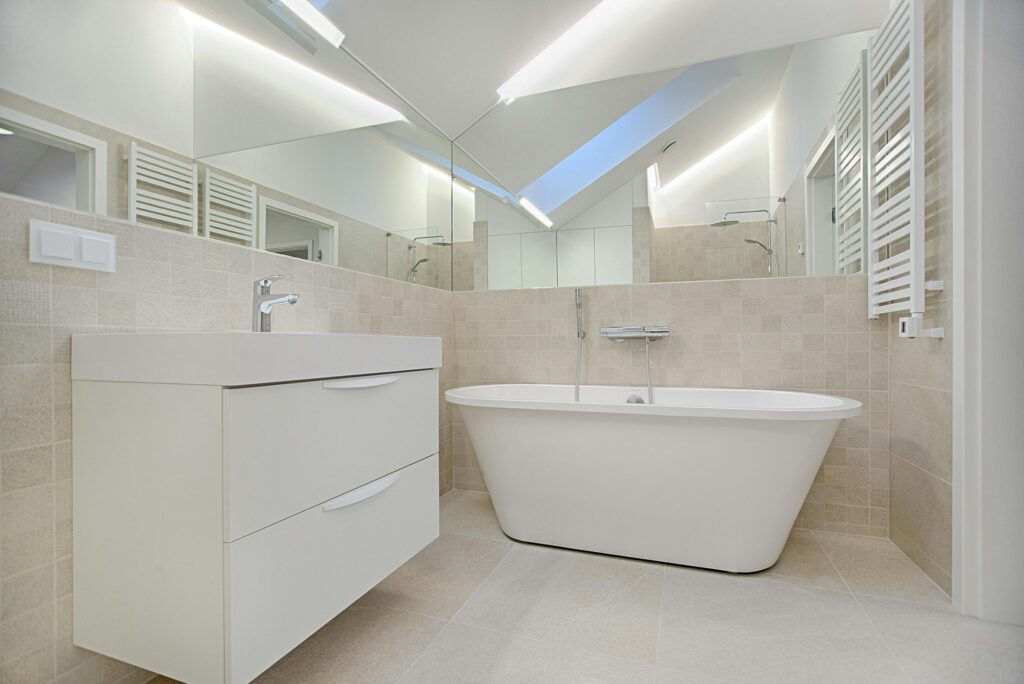
Stepping over a bath rim, often 500mm or more, is one of the most common danger points in bathroom use. For anyone with reduced balance, joint pain, lower limb weakness or a history of falls, that single movement can be the difference between independence and risk. A level-access shower removes the obstacle entirely.
Better for wheelchair users and carer access
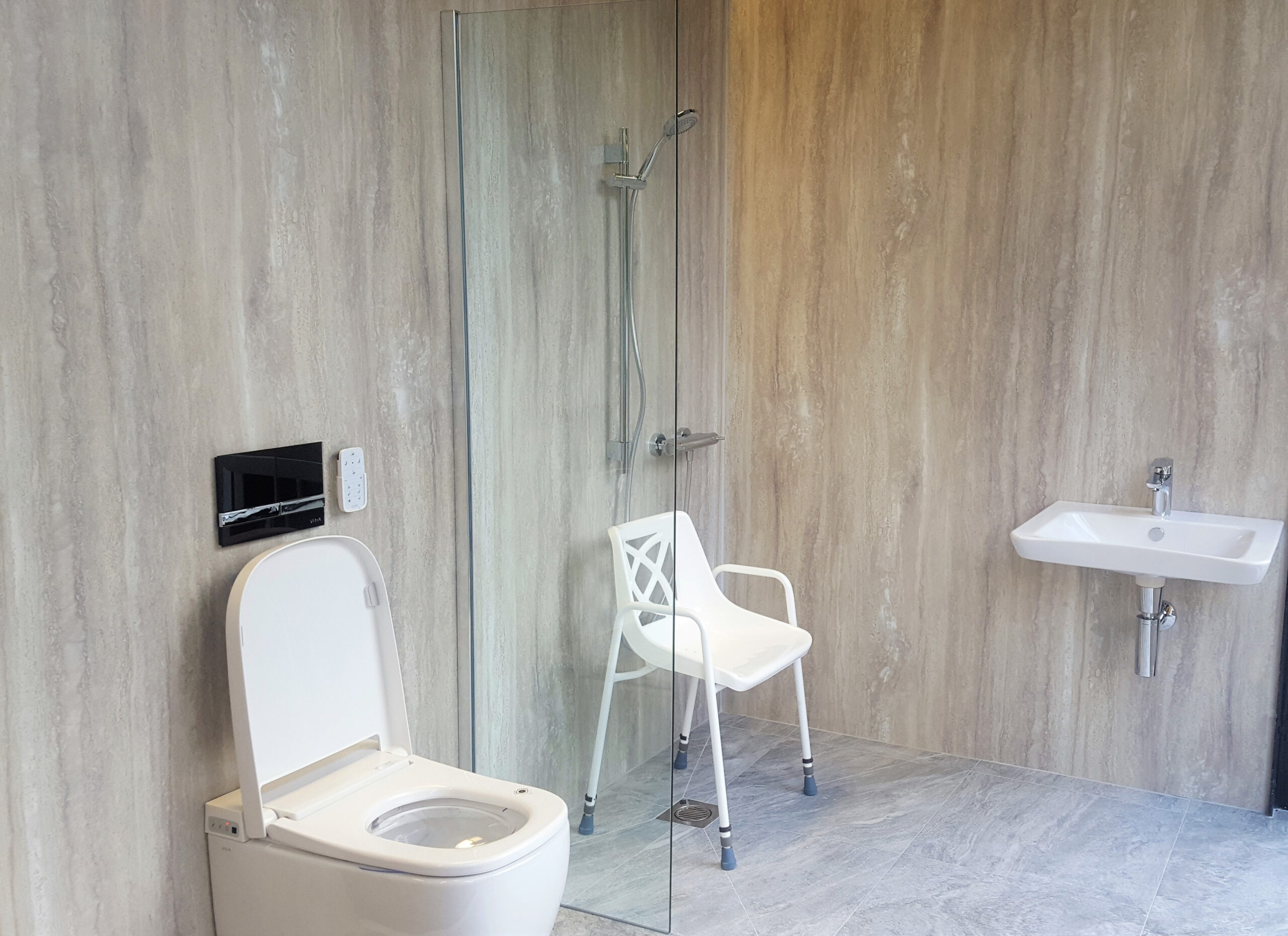
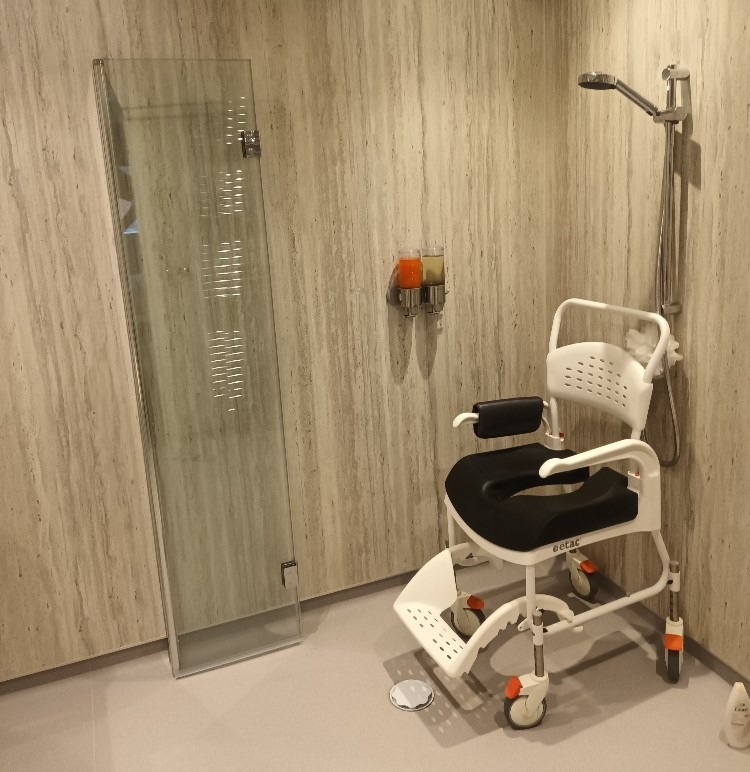
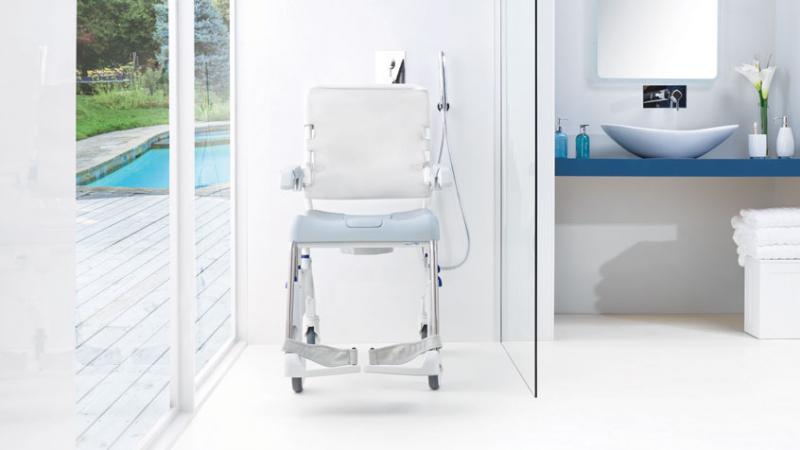
Wetrooms provide the open, unobstructed space that wheelchair users and carers need. A properly tanked wetroom with a linear drain allows a shower chair to roll straight in and gives a carer room to assist safely without the awkward and sometimes dangerous positioning that bathing in a traditional tub demands. Half-height shower screens can keep water contained while still allowing carer reach.
Easier to future-proof
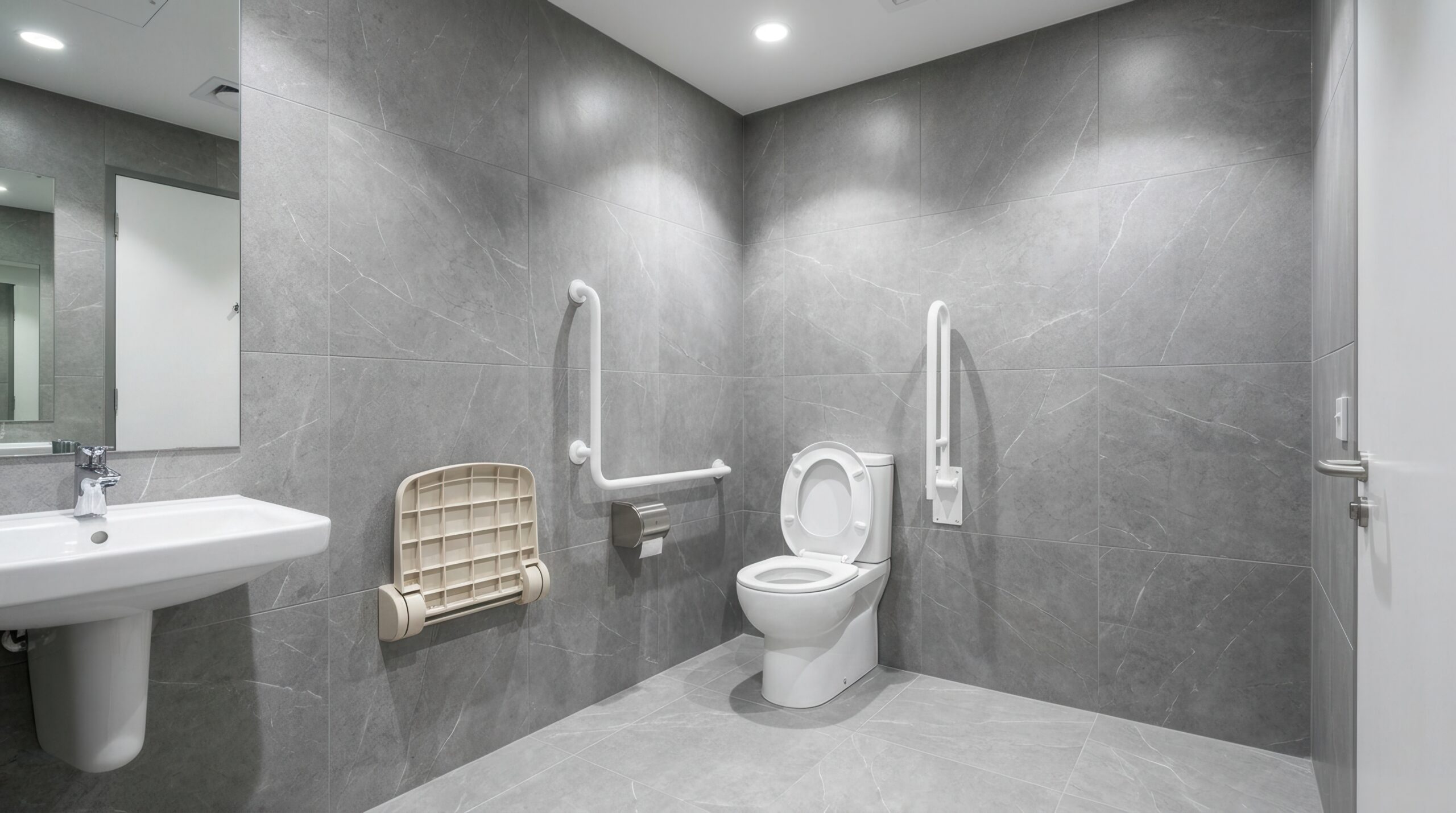
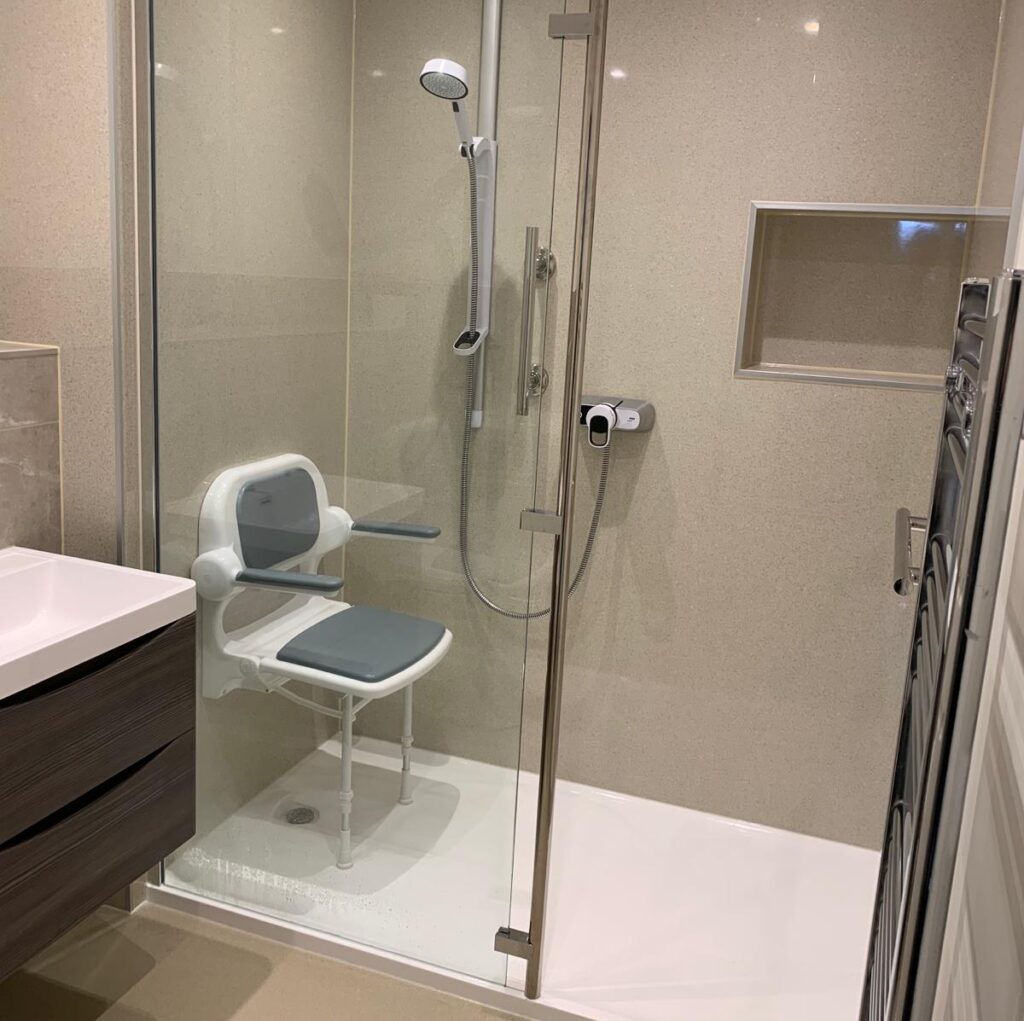
One of the classic traps in home adaptation is choosing what works just well enough today, only to find it no longer works a year or two later. A properly designed accessible shower gives more room for changing mobility, changing equipment and changing care arrangements. Walls can be reinforced during installation so that grab rails, a shower seat or a ceiling hoist can be added later without major building work.
Less physically demanding
For people who fatigue easily, such as those living with MS, COPD, chronic pain or recovering from surgery, the energy required to get in and out of a bath, sit down, wash and then stand again can be exhausting. A shower with a fold-down seat allows them to conserve energy while still maintaining independence and dignity.
Design appeal
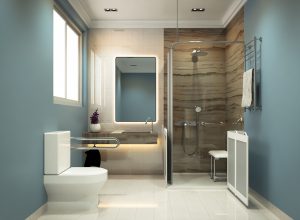
Level-access showers and wetrooms are also among the most attractive bathroom features available today. Large-format tiles, linear drains, frameless glass screening and coordinated brassware create a space that looks effortlessly modern. The fact that it also provides step-free access is, from a design perspective, simply a bonus. We covered this in detail in our recent blog on design tips for a stylish yet fully accessible bathroom.
When a Bath May Still Be the Better Choice
Therapeutic benefits that showering cannot replicate
Warm-water immersion helps to relax muscles, relieve joint pain and reduce spasticity. For people living with arthritis, cerebral palsy, muscular dystrophy or chronic pain, a daily bath can be a form of pain management that directly affects their wellbeing.
Specialist baths have advanced considerably
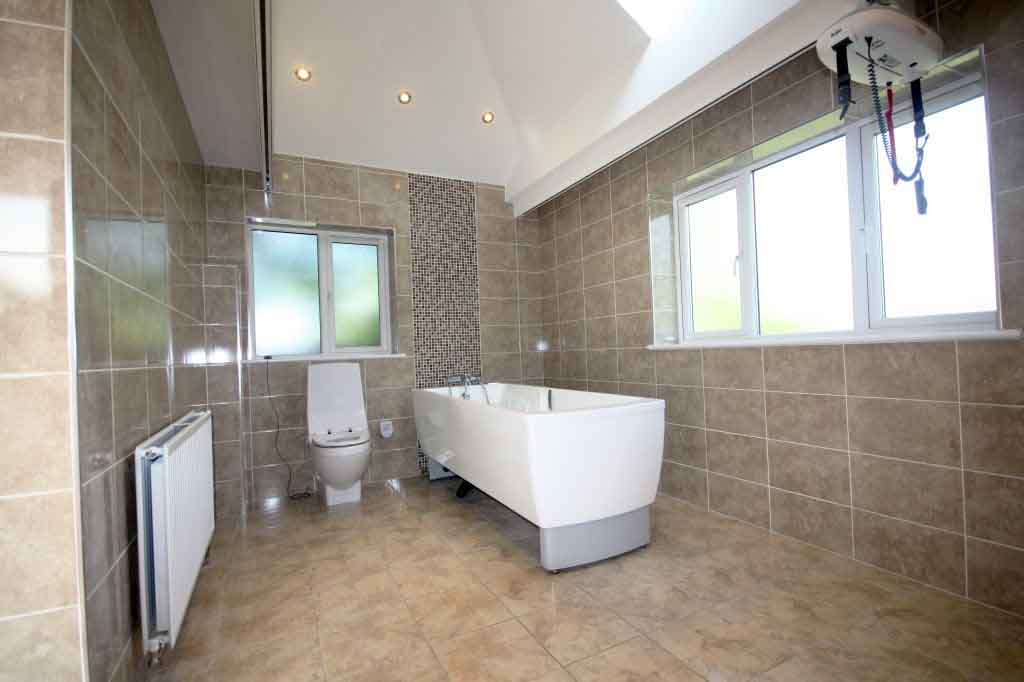
Height-adjustable (hi-lo) baths with powered transfer seats, integrated changing platforms and bespoke postural supports allow even people with very complex needs to bathe safely and comfortably. These baths also protect carers by providing ergonomic working heights and eliminating manual lifting. At Aquadapt, we supply and install a comprehensive range of bathing equipment and can advise on which products suit specific needs.
Side-by-Side Comparison
The table below summarises the key differences to help guide your decision.
| Factor | Accessible Shower | Accessible Bath |
| Ease of entry | Level access removes step-over risk entirely | Walk-in baths reduce but do not eliminate threshold; standard baths require full step-over |
| Speed and convenience | Generally quicker and less physically demanding | Slower; user must wait for filling and draining |
| Independence | Strong for standing or seated showering across a wide range of mobility levels | Can support comfort and dignity; may require more carer assistance |
| Carer access | Open layout allows safe assisted washing | Can be more restricted, especially in smaller rooms |
| Therapeutic value | More limited, running water does not offer immersion benefits | Warm-water immersion supports pain relief, relaxation and spasticity management |
| Space requirements | Wetrooms maximise tight footprints; shower area doubles as circulation space | Standard bath footprint, but specialist baths may need more room |
| Futureproofing | Easier to adapt as needs change over time | May need replacing if mobility declines significantly |
Why the Layout of Your Home Can Change the Answer
Here is the factor people often underestimate: the situation at the property itself.
A level-access shower may be ideal in principle, but the room still must work in practice. The size of the bathroom, the direction of the door, turning space, drainage, floor construction and whether a carer needs room to assist can all affect what is feasible. UK bathrooms are often compact, and fitting both a bath and a level-access shower is not always possible without significant structural work. Where only one can be accommodated, the choice usually comes down to which option best serves the primary user’s daily needs.
This is one of the reasons a professional site survey matters. On a website, almost any bathroom can look straightforward. In a real house, there may be structural quirks, awkward corners or limitations that change the best answer very quickly. Our experienced advisors work from measurements, movement and lived use, not from wishful thinking.

What an OT Will Usually Look At
A good occupational therapist will not begin with “Do you fancy a shower or a bath?” They will begin with a more useful set of observations: how the person transfers, whether they can stand safely, whether they tire quickly, whether there is a falls history, whether they use a walking aid or wheelchair, whether a carer is helping, how much room there is to move, and whether the proposed change is likely to remain suitable over time.
If you or someone you support is struggling with bathing, requesting an OT assessment through your GP or local authority social services team is a sensible first step. Private OT assessments are also available and can offer quicker access alongside detailed reports for grant applications.
Cost, Grants and the Funding Question
Cost matters, but the cheapest-looking option at first glance is not always the better value over time. Keeping a bath that no longer works safely may lead to increasing dependence, carer strain, near-misses or a rushed change later. Equally, the assumption that a bath is always more expensive than a shower is not always correct, a well-specified wetroom with premium finishes can cost as much as a specialist bath installation.
Many accessible bathroom projects in England can be supported by a Disabled Facilities Grant (DFG), administered by your local council. The current maximum is £30,000 per application (up to £36,000 in Wales). The DFG legislation specifically states that it can fund the provision of a bath or shower, or both, where that is assessed as necessary and appropriate. Following a significant funding increase for 2024–26, the national pot has grown to £711 million, meaning more resources and potentially shorter wait times in many areas. Qualifying work may also be eligible for VAT relief at 0% rather than the standard 20%.
We covered the full picture in our recent blog on the latest regulations and grants for accessible bathrooms in England.
Shower or Bath? Ask These Seven Questions First
If you are weighing up the decision for yourself or a family member, these seven questions tend to bring clarity quickly:
- Can the person step over a bath side safely and consistently?
- Can they sit down and stand up again without pain, instability or help?
- Can they stand long enough for a shower, or would a shower seat be needed?
- Is there a wheelchair, walker or carer to accommodate?
- Has there been a recent fall, near-fall or growing fear of falling?
- Is this meant to be a short-term fix or a solution for the next five to ten years?
- Does the size and layout of the bathroom support the option you are considering?
Sometimes those questions point strongly toward an accessible shower. Sometimes they show that a bath with the right support may still be suitable. Either way, they tend to move the conversation from guesswork to something much more solid.
Which Is Right for You?
For many people, especially where mobility is reduced or likely to change, an accessible shower is the better long-term option. It can reduce transfer risk, improve day-to-day ease, and create a bathroom that is more adaptable over time.
But a bath still has its place. In the right circumstances, and with the right support, it may remain the better choice for comfort, routine or therapeutic value. And where space and budget allow, having both a shower and a bath in the home is often the ideal solution, particularly for families.
The best answer is never a blanket rule. It is a considered decision based on the person, the property and the practicalities of daily life. If you are unsure which route is right, we strongly recommend you get expert advice, look carefully at how the bathroom is currently being used, and plan for what will work not just now, but well into the future.
This is exactly where Aquadapt can help. Whether the right answer for you is a shower, a bath, or both, over 35 years of experience enables us to help make the best decision.
Ready to Take the Next Step on your Accessible Bathroom Project?
Book a free site survey with one of our experienced advisors. We’ll visit your home, discuss your needs and preferences, and show you what’s possible. You can also visit our display showroom at Thorp Arch to see adapted bathroom environments in person.
Call us on 01423 799 499 or visit aquadapt.co.uk/book-appointment
Frequently Asked Questions
Is an accessible shower or a bath safer?
For most people with mobility challenges, a level-access shower or wetroom is the safer option because it removes the need to step over a bath rim and significantly reduces the risk of falls. However, a specialist bath with a powered transfer seat and height adjustment can be just as safe for many users when properly assessed and installed. The safest choice is always the one recommended after a thorough assessment of the individual’s needs.
Can a Disabled Facilities Grant fund a bath as well as a shower?
Yes. The Housing Grants, Construction and Regeneration Act 1996 states that a DFG can fund the provision of a bath or shower, or both, where this is assessed as necessary and appropriate. Some local authorities default to offering shower-only adaptations, but an occupational therapist can justify a bath recommendation where it is clinically and personally appropriate. The current maximum DFG in England is £30,000 per application (£36,000 in Wales).
What is the difference between a wetroom and a walk-in shower?
A wetroom is a fully waterproofed bathroom where the entire floor is sealed and gently graded towards a drain, removing the need for a shower tray. A walk-in shower uses a low-profile or level-access tray with an open entry point. Both are excellent for accessibility. Wetrooms offer the most seamless, barrier-free look, while level-access trays can sometimes be easier to install and provide slightly better water containment.
Will removing my bath reduce the value of my home?
Estate agents generally advise retaining at least one bath in a property, if possible, particularly when there is only one bathroom. However, for a household that needs an accessible bathroom, safety and independence should always take priority. Where space and budget allow, designing a layout that accommodates both a shower and a bath can address accessibility and property value together.
Who decides whether I should have a shower or a bath?
If you are applying for a Disabled Facilities Grant, an occupational therapist will assess your needs and recommend what is necessary and appropriate. They will consider your physical capabilities, your daily routine, the needs of any carers, and how your condition may change over time. If you are funding the project privately, the choice is yours, though Aquadapt always recommends consulting an OT to ensure the solution will remain suitable long term.
What bathing equipment can make a standard bath safer?
There is a wide range of equipment that can help make bathing in a standard bath safer without removing it. Options include bath boards, bath seats, swivel seats, inflatable bathing cushions and powered bath lifts. Grab rails fitted to reinforced walls also provide essential support when getting in and out.